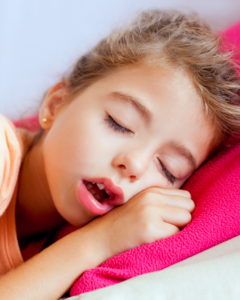

Mouth breathing in children changes how the face, teeth and sleep develop. Parents often arrive worried about night-time grinding, and this turns out to be the underlying thread.
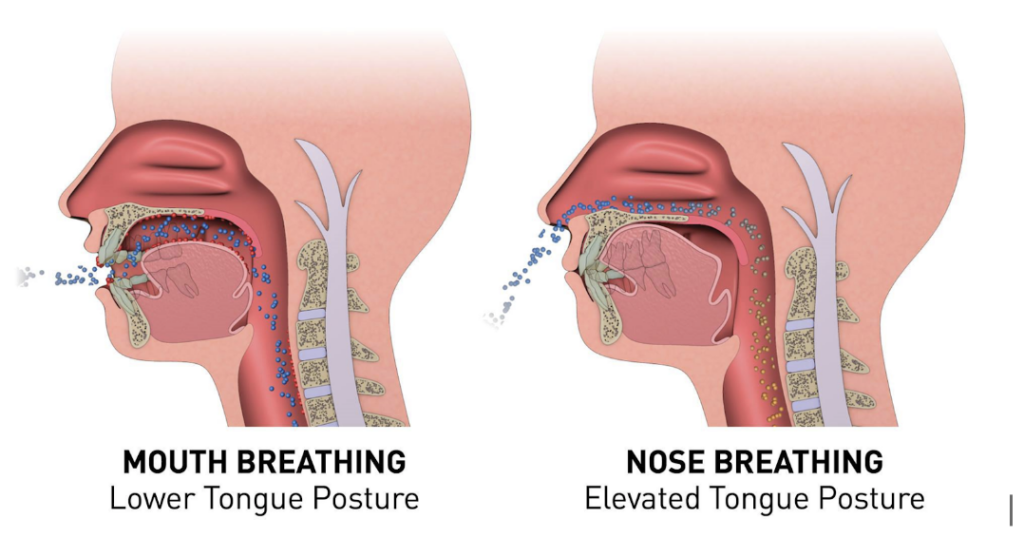
The questions that matter
A pediatric dentist naturally checks the bite first. However, a child’s mouth and facial movements deserve equal attention.
So the evaluation widens. Does the child breathe through the mouth or nose? Do they struggle to sleep? Do they get frequent coughs or colds? Was breastfeeding difficult? Do they snore or drool at night? These answers shape an accurate diagnosis.
What mouth breathing is
Mouth breathing in children means breathing primarily through the mouth, and it currently affects roughly fifty-five percent of children.
Nasal breathing filters foreign particles from the environment, so air reaches the lungs with fewer contaminants. Mouth breathing in children skips that filter. Consequently colds, nose and throat infections, and chronic ear infections all become more likely.
Common causes
- Problems with mouth and bite structure
- Enlarged tonsils and adenoids
- Nasal congestion from allergies
- A deviated septum
Signs to watch for
- Chronic fatigue
- Hoarseness and bad breath
- Dry, cracked lips
- Teeth grinding
- Snoring
- Irritability
What it leads to
Left unaddressed, the effects compound. An underdeveloped jaw, lip incompetence, crowded teeth and narrow facial features can all follow. So can frequent night waking, daytime sleepiness and increased behavioural problems.
Eating changes too. A child chews with the lips apart, which is noisier and less efficient. That can cause digestive issues, and even choking risk when coordinating breathing with a full mouth.
When swallowing, the tongue may protrude between the front teeth. Children often compensate with tension around the mouth or extra head movement. Chewing and swallowing strength drops, so they prefer softer foods or use liquid to help. Picky eating is therefore frequently a consequence rather than a habit.
Speech shows it as well. Tongue protrusion distorts /s/ and /z/, while low tongue placement affects /t, d, n, l/. Daytime patterns appear while sleeping, watching television, reading or sitting in a car seat, when the facial muscles relax. Ultimately, mouth breathing can be the root of sleep-disordered breathing.
How myofunctional therapy helps
Treatment usually involves a team, which may include ENT specialists, allergists, airway-centric pediatric dentists and orthodontists, plus physical and occupational therapists.
Myofunctional therapy establishes a correct oral rest posture. In that posture the tongue rests at the roof of the mouth, the teeth close gently, and the lips stay together.
Exercises then address nasal breathing, lip closure and tongue suction to the palate. In addition, therapy works on tongue and lip placement during chewing, swallowing and speech.
Simple measures at home
- Keep a consistent sleep schedule
- No screens for at least two hours before bed
- Soft music and guided deep breathing before sleep
For mouth breathing in children, early diagnosis, proper education and timely guidance remain the key factors. Wider context sits in airway centric dentistry and Buteyko breathing. The American Academy of Pediatric Dentistry also links breathing, sleep and growth.
Book an airway assessment in Dubai
If your child grinds, snores or sleeps with an open mouth, an early assessment is worthwhile. Call +971 50 682 3462 or book an appointment with Dr. Imneet Madan in Dubai.